Chinese Civil Procedure Law of 2012 Ch 9 ââåpreservation and Advance Enforcementã¢ââ Art 100
The ceremonious service is a collective term for a sector of authorities composed mainly of career civil servants hired on professional merit rather than appointed or elected, whose institutional tenure typically survives transitions of political leadership. A ceremonious servant, as well known equally a public retainer, is a person employed in the public sector by a authorities department or bureau for public sector undertakings. Civil servants work for primal and country governments, and respond to the authorities, not a political party.[1] [two]
The extent of civil servants of a land as part of the "civil service" varies from country to country. In the Britain (UK), for example, merely Crown (national government) employees are referred to every bit "ceremonious servants" whereas employees of local authorities (counties, cities and similar administrations) are generally referred to as "local government civil service officers", who are considered public servants but not ceremonious servants. Thus, in the Uk, a civil servant is a public retainer merely a public servant is not necessarily a civil servant.
The study of the civil service is a part of the field of public service (and in some countries there is no distinction between the ii). Staff members in "non-departmental public bodies" (sometimes called "QUANGOs") may too be classed equally civil servants for the purpose of statistics and maybe for their terms and conditions. Collectively a land's ceremonious servants grade its civil service or public service. The concept arose in China and modern ceremonious service developed in United kingdom of great britain and northern ireland in the 18th century.
An international ceremonious servant or international staff member is a noncombatant employee who is employed by an intergovernmental arrangement. These international civil servants do not resort under whatever national legislation (from which they have amnesty of jurisdiction) but are governed by internal staff regulations. All disputes related to international civil service are brought before special tribunals created past these international organizations such equally, for instance, the Administrative Tribunal of the ILO. Specific referral tin can exist made to the International Civil Service Commission (ICSC) of the United nations, an contained proficient body established by the United Nations General Assembly. Its mandate is to regulate and coordinate the atmospheric condition of service of staff in the United Nations common system, while promoting and maintaining high standards in the international civil service.
History [edit]
In Cathay [edit]
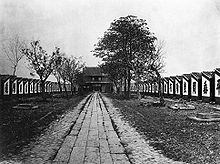
Royal Ceremonious Service Test hall with 7500 cells in Guangdong, 1873

The origin of the modern meritocratic civil service can be traced back to Imperial examination founded in Imperial China.[3] The Majestic examination based on merit was designed to select the all-time administrative officials for the state's hierarchy.[4] This system had a huge influence on both society and civilisation in Imperial Mainland china and was directly responsible for the creation of a class of scholar-bureaucrats irrespective of their family full-blooded.[5]
Originally appointments to the bureaucracy were based on the patronage of aristocrats; During Han dynasty, Emperor Wu of Han established the xiaolian organisation of recommendation past superiors for appointments to office. In the areas of administration, especially the military, appointments were based solely on merit. This was an early class of the imperial examinations, transitioning from inheritance and patronage to merit, in which local officials would select candidates to take part in an exam of the Confucian classics.[5] Later the fall of the Han dynasty, the Chinese bureaucracy regressed into a semi-merit system known equally the nine-rank arrangement.
This organisation was reversed during the short-lived Sui dynasty (581–618), which initiated a civil service bureaucracy recruited through written examinations and recommendation. The first civil service test system was established by Emperor Wen of Sui. Emperor Yang of Sui established a new category of recommended candidates for the mandarinate in AD 605. The following Tang dynasty (618–907) adopted the same measures for drafting officials, and decreasingly relied on aristocratic recommendations and more than and more on promotion based on the results of written examinations. The structure of the examination system was extensively expanded during the reign of Wu Zetian.[vi] The arrangement reached its apogee during the Song dynasty.[7]
In theory, the Chinese civil service system provided one of the master avenues for social mobility in Chinese society, although in practice, due to the time-consuming nature of the written report, the exam was by and large only taken by sons of the landed gentry.[8] The examination tested the candidate'southward memorization of the Nine Classics of Confucianism and his power to compose poetry using stock-still and traditional forms and calligraphy. It was ideally suited to literary candidates. Thus, toward the end of the Ming Dynasty, the organisation attracted the campaigning of Tang Xianzu (1550-1616). Tang at 14 passed the royal examination at the canton level; and at 21, he did so at the provincial level; only not until he was 34 did he laissez passer at the national level. However, he had already go a well-known poet at age 12, and among other things he went on to such distinction as a profound literati and dramatist that it would not be far-fetched to regard him as China's answer to William Shakespeare: Wang Rongpei and Zhang Ling (eds), The Complete Works of Tang Xianzu (2018). In the late 19th century, however, the system increasingly engendered internal dissatisfaction, and was criticized every bit not reflecting candidates' ability to govern well, and for giving undue weight to style over content and originality of thought. Indeed, long before its abandonment, the notion of the majestic arrangement as a route to social mobility was somewhat mythical. In Tang's magnum opus, The Peony Pavilion, sc 13, Leaving Dwelling house, the male lead, Liu Mengmei, laments: "After twenty years of studies, I still have no hope of getting into office", and on this point Tang may be speaking through Liu equally his alter ego. The system was finally abolished past the Qing regime in 1905 as part of the New Policies reform bundle.
The Chinese arrangement was often admired by European commentators from the 16th century onward.[9] However, the Chinese majestic exam system was hardly universally admired past all Europeans who knew of it. In a debate in the unelected bedroom of the UK parliament on March 13, 1854, John Browne 'pointed out [clearly with some disdain ] that the just precedent for appointing civil servants by literary exams was that of the Chinese regime': Coolican (2018), ch.v: The Northcote-Trevelyan Study, pp106–107.
Modern civil service [edit]
In the 18th century, in response to economic changes and the growth of the British Empire, the bureaucracy of institutions such equally the Part of Works and the Navy Board greatly expanded. Each had its own system, but in general, staff were appointed through patronage or outright buy. By the 19th century, it became increasingly articulate that these arrangements were falling brusque. "The origins of the British civil service are ameliorate known. During the eighteenth century a number of Englishmen wrote in praise of the Chinese examination system, some of them going and so far as to urge the adoption for England of something like. The kickoff concrete step in this direction was taken by the British East India Company in 1806."[10] In that year, the Honourable East India Company established a college, the East India Company College, near London to train and examine administrators of the company's territories in Republic of india.[xi] "The proposal for establishing this college came, significantly, from members of the East Bharat Visitor's trading post in County, China."[10] Examinations for the Indian "civil service"—a term coined past the Company—were introduced in 1829.[12]
British efforts at reform were influenced by the majestic examinations system and meritocratic arrangement of China. Thomas Taylor Meadows, United kingdom of great britain and northern ireland'southward consul in Guangzhou, China argued in his Sporadic Notes on the Regime and People of China, published in 1847, that "the long elapsing of the Chinese empire is solely and altogether owing to the expert government which consists in the advancement of men of talent and merit only," and that the British must reform their ceremonious service by making the establishment meritocratic.[10] On the other manus, John Browne, in the 1854 debate mentioned above, 'argued that elegant writing had get an end in itself, and the stultifying effect of this on the Chinese civil service had contributed in no small measure to Communist china's failure to develop its early atomic number 82 over Western civilisations': Coolican, p107.

In 1853 the Chancellor of the Exchequer William Gladstone, deputed Sir Stafford Northcote and Charles Trevelyan to await into the operation and system of the Civil Service. Influenced past the Chinese imperial examinations, the Northcote–Trevelyan Report of 1854 fabricated four principal recommendations: that recruitment should be on the basis of merit determined through competitive examination, that candidates should have a solid general pedagogy to enable inter-departmental transfers, that recruits should be graded into a hierarchy and that promotion should be through achievement, rather than "preferment, patronage or purchase". It too recommended a clear sectionalization between staff responsible for routine ("mechanical") work, and those engaged in policy conception and implementation in an "authoritative" class.[13]
The report was well-timed, because bureaucratic chaos during the Crimean War was causing a clamour for the modify. The report'southward conclusions were immediately implemented, and a permanent, unified and politically neutral ceremonious service was introduced as Her Majesty's Civil Service. A Ceremonious Service Commission was also set up in 1855 to oversee open recruitment and end patronage, and most of the other Northcote–Trevelyan recommendations were implemented over some years.[xiv] Or so one version of the story goes.
There are, however, more nuanced means to tell the tale.
Despite [civil servants'] many similarities, at that place too exists a great divide between the very small number of peak mandarins and the very great number of more junior staff. ... the conventional wisdom is that this divide was the work of Sir Stafford Northcote and Sir Charles Trevelyan, but once you commencement poking effectually in the archives the story turns out to be rather more complicated. ... What is surprising is that, as originally drafted, the report independent merely the near meagre proposals for establishing entry to the ceremonious service via a competitive literary exam - i for intellectuals and i for mechanicals. At that place was such a proposal merely it did not extend to departments subordinate to the Treasury. ... Gladstone warmly supported other aspects of the report simply criticised its limited set on on patronage. ... He wanted the principle of competition 'sanctioned in its full latitude', and applied to the Treasury 'with unsparing vigour' [and] when the amended report was published nigh a twelvemonth later it proposed to apply the competitive principle to all departments. ... Early in 1854, [Prime Minister] Russell wrote to Gladstone to say he hoped Gladstone was 'not thinking seriously of the plan of throwing open up to contest the whole civil service of this country'. ... The departmental heads, in their response to the report, likewise criticised the thinking underlying the proposals for change... the Northcote-Trevelyan report was dead in the h2o. ... In the face of opposition from top civil servants, and a distinct lack of enthusiasm on the part of most ministers - particularly the Prime Minister - Gladstone was non inclined to push the matter too hard. The idea of a central competitive exam was dropped, along with most of the other proposals. Simply i other proposal was put into outcome; in 1854... the Cabinet agreed to the creation of a central examining board. A year later the Civil Service Committee was established ...
—Coolican, op. cit., pp 4, 95, 96, 105, 110, 112
The same model, the Imperial Civil Service, was implemented in British India from 1858, after the demise of the East India Company's dominion in India through the Indian Rebellion of 1857 which came close to toppling British dominion in the country.[xv]
The Northcote–Trevelyan model remained essentially stable for a hundred years. This was a tribute to its success in removing corruption, delivering public services (even under the stress of 2 world wars), and responding effectively to political alter. Information technology as well had a bully international influence and was adapted by members of the Commonwealth. The Pendleton Civil Service Reform Act established a modern civil service in the United States, and by the plough of the 20th century almost all Western governments had implemented like reforms.
By country [edit]
Americas [edit]
Brazil [edit]
Civil servants in Brazil (Portuguese: servidores públicos) are those working in the executive, legislative, and judicial branches of the Federal, state, Federal District or municipal governments, including congressmen, senators, mayors, ministers, the president of the republic, and workers in regime-owned corporations.
Career civil servants (non temporary workers or politicians) are hired but externally on the basis of archway examinations (Portuguese: concurso público).[16] It commonly consists of a written test; some posts may require physical tests (such equally policemen), or oral tests (such equally professors, judges, prosecutors and attorneys). The rank co-ordinate to the examination score is used for filling the vacancies.
Archway examinations are conducted by several institutions with a authorities mandate, such equally CESPE (which belongs to the University of Brasília) and the Cesgranrio Foundation (which is role of the Federal Academy of Rio de Janeiro).
The labor laws and social insurance for civil servants are unlike from private workers; even between government branches (like different states or cities), the police and insurance differ.
The posts commonly are ranked by titles, the well-nigh common are technician for loftier schoolhouse literates and analyst for undergraduates. In that location'southward also higher post ranks like auditor, fiscal, chief of police, prosecutor, judge, attorney, etc.
The police does not allow servants to upgrade or downgrade posts internally; they need to be selected in separate external entrance examinations.
Canada [edit]
Historians have explored the powerful role of ceremonious service since the 1840s.[17]
In Canada, the civil service at the federal level is known equally the Public Service of Canada, with each of the 10 provincial governments also as the three territorial governments too having their ain separate ceremonious services. The federal civil service consists of all employees of the crown except for ministers' exempt staff, members of the Regal Canadian Mounted Constabulary, and members of the Canadian Armed Forces as they are not civil servants.[18] There are approximately 257,000 federal civil servants (2015),[xviii] and more than 350,000 employees at the provincial and territorial levels.[19]
United States [edit]
In the United States, the federal civil service was established in 1871. The Civil Service is divers as "all appointive positions in the executive, judicial, and legislative branches of the Authorities of the U.s., except positions in the uniformed services." (5 U.S.C. § 2101). In the early on 19th century, government jobs were held at the pleasure of the president — a person could be fired at any fourth dimension. The spoils system meant that jobs were used to support the political parties. This was changed in wearisome stages by the Pendleton Ceremonious Service Reform Act of 1883 and subsequent laws. By 1909, almost 2 thirds of the U.Due south. federal piece of work force was appointed based on merit, that is, qualifications measured past tests. Certain senior civil service positions, including some heads of diplomatic missions and executive agencies, are filled past political appointees. Nether the Hatch Act of 1939, civil servants are not allowed to engage in political activities while performing their duties.
The U.S civil service includes the competitive service and the excepted service. The majority of civil service appointments in the U.S. are made under the competitive service, merely the Strange Service, the FBI, and other National Security positions are made under the excepted service. (U.S. Code Title V)
U.Due south. state and local government entities often accept competitive civil service systems that are modeled on the national system, in varying degrees.
As of January 2007, the federal authorities, excluding the Postal Service, employed about 1.8 million civilian workers. The federal government is the nation's single largest employer, although it employs but about 12% of all government employees, compared to 24% at the state level and 63% at the local level.[xx] Although most federal agencies are based in the Washington, D.C. region, only about 16% (or about 284,000) of the federal regime workforce is employed in this region.[21]
As of 2014, at that place are currently xv federal executive co-operative agencies and hundreds of subagencies.[22]
Asia [edit]
Kingdom of cambodia [edit]
The Ceremonious Service (Khmer: សេវាកម្មស៊ីវិល, Sevakamm Civil) of Cambodia is the policy implementing arm of the Royal Government of Cambodia. In executing this of import role, each civil servant (Khmer: មន្រ្តីរាជការ, Montrey Reachkar) is obligated to act according to the law and is guided by public policy pronouncements. The Common Statute of Civil Servants is the master legislative framework for the Civil Service in Cambodia.[23]
China [edit]
History [edit]
One of the oldest examples of a civil service based on meritocracy is the Imperial bureaucracy of China, which can be traced as far back as the Qin dynasty (221–207 BC). Nevertheless, the ceremonious service examinations were practiced on a much smaller calibration in comparison to the stronger, centralized hierarchy of the Song dynasty (960–1279). In response to the regional military dominion of jiedushi and the loss of civil say-so during the belatedly Tang menstruation and Five Dynasties (907–960), the Song emperors were eager to implement a system where ceremonious officials would owe their social prestige to the cardinal courtroom and gain their salaries strictly from the central government. This ideal was not fully achieved since many scholar officials were flush landowners and were engaged in many anonymous business affairs in an age of economic revolution in Prc. Even so, gaining a caste through three levels of examination—prefectural exams, provincial exams, and the prestigious palace exams—was a far more than desirable goal in gild than condign a merchant. This was because the mercantile course was traditionally regarded with some disdain by the scholar-official form.
This class of state bureaucrats in the Vocal menstruum were far less aristocratic than their Tang predecessors. The examinations were carefully structured in society to ensure that people of bottom means than what was available to candidates born into wealthy, landowning families were given a greater gamble to pass the exams and obtain an official caste. This included the employment of a bureau of copyists who would rewrite all of the candidates' exams in order to mask their handwriting and thus preclude favoritism past graders of the exams who might otherwise recognize a candidate's handwriting. The advent of widespread printing in the Song menstruation immune many more than test candidates access to the Confucian texts whose mastery was required for passing the exams.
Electric current [edit]
Hong Kong and Macau accept separate civil service systems:
- Hong Kong Civil Service
- Secretariat for Administration and Justice is responsible for the ceremonious service in Macau
India [edit]
In India, the Civil Service is defined as "appointive positions by the Government in connexion with the affairs of the Matrimony and includes a civilian in a Defence Service, except positions in the Indian Armed Forces." The members of civil service serve at the pleasance of the President of India and Article 311 of the constitution protects them from politically motivated or vindictive activeness.
The Ceremonious Services of Bharat can exist classified into three types—the All India Services, the Central Civil Services (Group A and B) and State/Provincial Civil Services. The recruits are academy graduates (or above) selected through a rigorous system of examinations, called the Civil Services Examination (CSE) and its technical counterpart known as the Engineering Services Examination (ESE) both conducted by the Matrimony Public Service Commission (UPSC). The entry into the State Ceremonious Services is through a competitive examination conducted by every state public service commission.
Senior positions in civil service are listed and named in the Order of Precedence of Bharat.
Nihon [edit]
Pakistan [edit]
In Pakistan the FPSC (Federal Public Service Commission) conducts a competitive test for the Central Superior Services of Pakistan and other civil-service posts; Pakistan inherited this system from the British Raj-era Indian Civil Service.
Pakistan has federal civil servants serving in federal authorities offices, with staff selected through the Federal Public Service Commission. Similarly, Pakistani provinces select their own public servants through provincial Public Service Commissions. The federal services have some quota against provincial posts, while provincial services have some quota in federal services.
Taiwan [edit]
The ROC constitution specifies that public servant cannot be employed without examination. The employment is usually lifelong (that is, until age well-nigh retirement).
Europe [edit]
France [edit]
The civil service in France (fonction publique) is often incorrectly considered to include all government employees including employees of public corporations, such as SNCF.
Public sector employment is classified into three services; State service, Local service and Hospital service. According to government statistics there were five.5 million public sector employees in 2011.[24] [25]
| Category | Primal Government | Local Government | Health service | Total |
|---|---|---|---|---|
| Education | 1,360.vi | 1,360.6 | ||
| Police | 284.four | 40 | 324.4 | |
| Defense force | 280.vii | 280.7 | ||
| Wellness & Social | 241 | 1,153 | ane,394.0 | |
| Other | 516.1 | 1,631 | 2,147.1 | |
| Total | 2,441.viii | 1,912 | 1,153 | 5,506.8 |
| % Civil servants[26] | 62% | 75% | 72% | - |
Frg [edit]
The Public Service in Frg (Öffentlicher Dienst) employed 4.vi meg persons as of 2011[update].[27] Public servants are organized[28] into hired salaried employees (Arbeitnehmer), appointed civil servants (Beamte) and soldiers. They are employed past public bodies (Körperschaften des öffentlichen Rechts), such as counties (Kreise), states, the federal government, etc. In addition to employees directly employed past the state another 1.vi million persons are employed by state owned enterprises[29]
| Category | Federal Government | Regional Government | Municipal Regime | Social Security | Full |
|---|---|---|---|---|---|
| State employees | 458 | two,114.iv | 1,220.vii | 378.6 | 4,171.vii |
| government owned enterprises | 240.4 | 387.1 | 950.2 | 24.v | 1,602.1 |
| Total | 698.iv | ii,501.5 | 2,170.9 | 403.1 | 5,733.8 |
Beamte has been a championship for regime employees for several centuries in High german states, merely became a standardized group in 1794.[ citation needed ] Soldiers other than conscripted soldiers are not Beamte but take like rights. Judges are not Beamte but accept like rights as well.[thirty] Public attorneys are all Beamte, while most (just non all) professors are Beamte. The group of Beamte have the most secure employment, and the amount they are paid is set by national pay regulations (Besoldungsordnungen). Beamte are prohibited from striking.
Angestellte piece of work with private contracts, while Beamte are appointed, employed, and removed by the Public Sector Service and Loyalty law (öffentlich-rechtliches Dienst- und Treueverhältnis). Nigh tasks can exist either washed by Beschäftigte or Beamte, however some specific tasks of official nature are supposed to be handled by Beamte since they are subject to a special loyalty obligation.
Beamte are divided into four levels:
- Einfacher Dienst: ordinary civil service, corresponding to enlisted ranks in the military, now largely obsolete
- Mittlerer Dienst: medium-level civil service, corresponding to not-commissioned officers in the armed services
- Gehobener Dienst: senior civil service, including ceremonious servant positions such as Inspektor and to a higher place, respective to commissioned officers from lieutenant to helm in the military
- Höherer Dienst: college ceremonious service, including civil servant positions such as Rat (Councillor) and above as well every bit bookish employees such as Professors, corresponding to major and above in the military
Gehobener Dienst and Höherer Dienst both crave a university education or equivalent, at the very least a available's or master's caste, respectively.
Ireland [edit]
The civil service of Republic of ireland includes the employees of the Departments of State (excluded are regime ministers and a small number of paid political advisors) equally well as a small number of core state agencies such every bit the Function of the Acquirement Commissioners, the Role of Public Works, and the Public Appointments Service. The system of the Irish Ceremonious Service is very similar to the traditional organisation of the British Home Civil Service, and indeed the grading organisation in the Irish Civil Service is nearly identical to the traditional grading system of its British counterpart. In Ireland, public sector employees such as teachers or members of the country'southward police force, the Garda Síochána are not considered to exist ceremonious servants, but are rather described every bit "public servants" (and form the public service of the Republic of Ireland).
Russia [edit]
Spain [edit]
The ceremonious service in Kingdom of spain (función pública) is unremarkably considered to include all the employees at the different levels of the Spanish public administration: central regime, autonomous communities, equally well every bit municipalities. There are three main categories of Spanish public positions: temporary political posts ("personal eventual"), which require a simple process for hiring and dismissal and is associated to top level executives and advisors, statutory permanent posts ("funcionarios de carrera"), which require a formal procedure for access that normally involves a competition amidst candidates and whose tenants are subject field to a special statutory relationship of piece of work with their employers, and not statutory permanent posts ("personal laboral"), which likewise require a formal process for entry like to the process required for the "funcionarios de carrera", but whose tenants are bailiwick to normal working weather condition and laws. Competitions differ notably among the state, the 17 autonomous communities and the city councils, and the "funcionarios de carrera" and "personal laboral" examinations vary in difficulty from ane location to another.
Every bit of 2013,[31] there were 2.six one thousand thousand public employees in Spain, of which 571,000 were civil servants and 2 one thousand thousand were non-ceremonious servants.
| Category | Employee type | Key Government | Regional Government | Municipal | University | Total |
|---|---|---|---|---|---|---|
| Police | Ceremonious servants | 147 | 25 | 172 | ||
| Defense force | Ceremonious servants | 124 | 124 | |||
| Health & Social | Civil servants | 321 | 321 | |||
| other public employees | 170 | 170 | ||||
| Other | Ceremonious servants | 180 | 562 | 218 | 74 | 1034 |
| other public employees | 119 | 229 | 330 | 75 | 753 | |
| Full | Civil servants | 451 | 908 | 218 | 74 | 1651 |
| other public employees | 119 | 399 | 330 | 75 | 923 | |
| Total | 570 | 1307 | 548 | 149 | 2574 |
More recent figures can be establish at SEAT.[32]
In December 2011, the government of Rajoy announced that civil servants have to serve a minimum 37.5 working hours per calendar week regardless of their place or kind of service.[33]
U.k. [edit]
The civil service in the Uk only includes Crown (i.e. primal regime) employees, non parliamentary employees or local government employees. Public sector employees such every bit those in education and the NHS are non considered to be civil servants. Police officers and staff are also not civil servants. Total employment in the public sector in the Britain was 6.04 1000000 in 2012 according to the UK's Role for National Statistics.[34]
| Category | Fundamental government | Local government | Health service | Total |
|---|---|---|---|---|
| Police force | 278,000 | 278,000 | ||
| Defence | 193,000 | 193,000 | ||
| Health & Social | 364,000 | i,565,000 | 1,929,000 | |
| Other | 1,989,000 | 42,000 | 2,031,000 | |
| Full | 2,182,000 | 2,290,000 | 1,565,000 | 6,037,000 |
Civil servants in the devolved government in Northern Ireland are non part of the Home Civil Service, merely constitute the divide Northern Republic of ireland Civil Service. Some employees of the Foreign and Commonwealth Role are members of HM Diplomatic Service, which is associated with but separate from the Civil Service.
European Union [edit]
The European Ceremonious Service administers the institutions of the European Union, of which the largest employer is the European Commission.
Civil servants are recruited directly into the institutions afterward being selected by competitions set past EPSO, the official selection office. They are allocated to departments, known every bit Directorates-Full general (DGs), each roofing ane or more than related policy areas.
Civil service independence [edit]
Autocratic systems of authorities (such equally monarchies) can favour appointments to administrative positions on the basis of nepotism, patronage and favoritism, with shut relationships betwixt political and authoritative figures. Early Roman emperors, for example, prepare their household slaves and freedmen much of the task of administering the Empire,[35] sidelining the elected officials who continued the traditions of the Roman Democracy. Merely the political date of bureaucrats can run the hazard of tolerating inefficiency and abuse, with officials feeling secure in the protection of their political masters and possibly immune from prosecution for bribe-taking. Song-dynasty China (960–1279) standardised competitive examinations as a basis for civil-service recruitment and promotion, and in the 19th century administrations in France and U.k. followed suit. Agitation against the spoils organisation in the U.s.a. resulted in increasing the independence of the civil service – seen as an of import principle in modern times.[36]
Some governmental structures include a civil service committee (or equivalent) whose functions include maintaining the piece of work and rights of ceremonious servants at arm's length from potential politicisation or political interference.[37] Compare the governance-administrative integration of Stalin'southward Orgburo.
See too [edit]
General [edit]
- Civic engineering
- Civil service commission
- Civil service examination
- Civil service organization
- Community service
- Public service
Past continent or region [edit]
- Civil service reform in developing countries e.g. Nigeria, Congo, etc.
Africa [edit]
- Nigerian Civil Service
- Civil Service Commission of Nigeria
- Rivers State Civil Service
Asia [edit]
- Ceremonious Service of the People's Republic of China
- Civil Services of India
- Ceremonious Service in early India
- Civil Services of Tamil Nadu
- Ceremonious service of Japan
- Civil service in Malaysia
- Civil Services of Islamic republic of pakistan
- Ceremonious Service Commission (Philippines)
- Civil Service of Singapore
Europe [edit]
- Civil Service of the Eu
- Civil Service of Germany
- Civil Service of the Commonwealth of Ireland
- Ceremonious Service of the Britain
- Civil Service Commission
- Ceremonious Service Committee (Isle of mann)
- Civil Service Restoration Human activity
North America [edit]
- Public Service of Canada
- Minister responsible (Manitoba)
- Civil service in the The states
- Civil Service Commission
- Civil service reform
- Civil service reform deed
- Civil Service Reform Human action of 1978
Oceania [edit]
- Australian Public Service
- New Zealand Public Service Departments
Due south America [edit]
- Civil service in Brazil
Pay and benefits [edit]
- Performance-related pay
- Pay-for-Functioning (Federal Authorities)
- Pay for functioning (healthcare)
- Pay to play
- Functioning-related pay
- Incentive program
United States [edit]
- Ceremonious Service Retirement System
- Merit pay (Federal Government Merit Pay)
- Pay-for-Performance (Federal Government)
- Pay for performance (human being resources)
- 2014 Veterans Health Administration scandal
References [edit]
- ^ "UK Civil Service - Definitions - What is a Ceremonious Servant?". civilservant.org.uk. Archived from the original on 11 Oct 2019. Retrieved 5 November 2019.
- ^ "Managing Conflict of Interest in the Public Service - OECD". System for Economical Co-functioning and Evolution (OECD). 2005. Archived from the original on 2019-08-05. Retrieved 2018-12-09 .
- ^ "China'due south Test Hell: The Civil Service Examinations of Royal China". History Today. Archived from the original on March xix, 2012. Retrieved October 25, 2011.
- ^ "Imperial China: Ceremonious Service Examinations" (PDF). Princeton University. Archived (PDF) from the original on April 1, 2011. Retrieved Oct 25, 2011.
- ^ a b "Confucianism and the Chinese Scholastic System: The Chinese Royal Examination Arrangement". California Land Polytechnic University, Pomona. Archived from the original on April eighteen, 2000. Retrieved Dec vii, 2011.
- ^ Paludan, Ann (1998). Chronicle of the Chinese Emperors: The Reign-past-Reign Tape of the Rulers of Imperial China. New York, New York: Thames and Hudson. ISBN 0-500-05090-2
- ^ Roberts, J. A. G. (1999). A Curtailed History of China . Cambridge, MA: Harvard University Press. ISBN0-674-00075-seven.
- ^ "Chinese civil service". Encyclopædia Britannica. Archived from the original on December 16, 2011. Retrieved Dec 7, 2011.
- ^ Brook, Timothy (1999). Cathay and Historical Capitalism. New York: Cambridge Academy Press. ISBN0-521-64029-6.
- ^ a b c Bodde, Derke. "Mainland china: A Teaching Workbook". Columbia University. Archived from the original on 2012-01-04. Retrieved 2012-08-05 .
- ^ (Bodde 2005)
- ^ Mark W. Huddleston, William W. Boyer (1996). The Higher Ceremonious Service in the United States: Quest for Reform . University of Pittsburgh Press. ISBN9780822974734.
- ^ Kazin, Edwards, and Rothman (2010), 142.
- ^ Walker, David (2003-07-09). "Fair game". The Guardian. London. Archived from the original on 2013-12-28. Retrieved 2003-07-09 .
- ^ Naithani, Sadhana (2006). In quest of Indian folktales: Pandit Ram Gharib Chaube and William Crooke. Indiana University Press. p. vi. ISBN978-0-253-34544-8. Archived from the original on 2016-05-12. Retrieved 2015-10-xiv .
- ^ "Concurso Público In Brazil". The Brazil Business. Archived from the original on 2021-09-12. Retrieved 2021-09-12 .
- ^ R. MacGregor Dawson, The Ceremonious Service of Canada (1929); Jack Granatstein, The Ottawa Men: The Civil Service Mandarins, 1935-1957 (Oxford Upwardly, 1982); J.E. Hodgetts, Pioneer Public Service: An Administrative History of United Canada, 1841-1867. (U of Toronto Press, 1955).
- ^ a b Authorities of Canada (2011-04-18). "Population of the Federal Public Service". Her Majesty the Queen in Right of Canada. Archived from the original on 2016-06-22. Retrieved 25 June 2016.
- ^ "ENAP – Canadian governments compared > Provincial". etatscanadiens-canadiangovernments.enap.ca. Archived from the original on 2011-09-13. Retrieved 2011-07-27 .
- ^ "2012 Census of Governments: Employment Summary Report" (PDF). United states Census Bureau. 6 March 2014. Archived (PDF) from the original on 28 March 2015. Retrieved 8 December 2014.
- ^ "Federal Government, Excluding the Postal service". Bureau of Labor Statistics. March 12, 2008. Archived from the original on 2009-01-14.
- ^ "Louisiana Land University Libraries – Federal Agency Index". Lib.lsu.edu. 2009-09-15. Archived from the original on 2014-09-24. Retrieved 2014-02-xviii .
- ^ "Handbook For Ceremonious Servants" (PDF). Archived (PDF) from the original on 2020-02-twenty. Retrieved 2020-02-20 .
- ^ "Résultats de la recherche – Insee". www.insee.fr. Archived from the original on 2015-04-26. Retrieved 2015-04-03 .
- ^ "Local Authorities employment statistics" (PDF). Archived (PDF) from the original on 2015-09-23. Retrieved 2015-04-03 .
- ^ "L'emploi dans la fonction publique en 2012 – Insee Première – 1496". www.insee.fr. Archived from the original on 2015-09-24. Retrieved 2015-06-20 .
- ^ Index Gute Arbeit: Sonderauswertung Öffentlicher Dienst 2011 Archived 2017-12-06 at the Wayback Machine DGB (PDF, German)
- ^ "Beschäftigte im öffentlichen Dienst". Bundesministerium des Innern, für Bau und Heimat. Archived from the original on 11 September 2019. Retrieved xi September 2019.
- ^ "State employees as of June 2013". Archived from the original on 2015-02-21.
- ^ "Beihilfe für Richter golden wie für Beamte – beihilferatgeber.de". world wide web.beihilferatgeber.de. Archived from the original on 2015-11-22. Retrieved 2015-11-21 .
- ^ "Portales SEAT y SEFP:: Secretaría de Estado para las Administraciones Territoriales :: Secretaría de Estado de Función Pública" (PDF). world wide web.seap.minhap.gob.es. Archived from the original (PDF) on 2015-06-21. Retrieved 2015-06-xx .
- ^ "El empleo público en España" (PDF). www.seat.mpr.gob.es (in Spanish). Archived (PDF) from the original on 2020-02-25. Retrieved 2020-02-25 .
- ^ Calvo, Vera Gutiérrez (2011-12-30). "Los funcionarios trabajarán 37,5 horas y su sueldo sigue congelado | Política | EL PAÍS". El País. Politica.elpais.com. Archived from the original on 2014-08-23. Retrieved 2014-02-18 .
- ^ Statistics, David Matthews, Office for National (2011-09-14). "Public Sector Employment, Q2 2011". www.ons.gov.uk. Archived from the original on 2015-04-09. Retrieved 2015-04-03 .
- ^ Compare: Boardman, John (2000). The Cambridge Aboriginal History: The High Empire, A.D. 70–192. The Cambridge Ancient History. Vol. 11 (2 ed.). Cambridge Academy Printing. p. 195. ISBN9780521228046. Archived from the original on 2020-02-28. Retrieved 2018-05-01 .
Members of higher social groups, such every bit senators or equites, necessarily had more of an opportunity to influence the emperor, yet men of lower social status, for example freedmen or slaves, could also make their marking on account of their abiding proximity to the emperor.
- '^ Verheijen, Tony (2008). "Independent Civil Service Systems: a Contested Value?". In Grotz, Florian; Toonen, Thursday. A. J. (eds.). Crossing Borders: Constitutional Development and Internationalisation: Essays in Honour of Joachim Jens Hesse . Berlin: Walter de Gruyter. p. 249. ISBN9783899495874. Archived from the original on 2020-07-29. Retrieved 2018-04-30 .
The importance of a professional and impartial ceremonious service has been a virtually uncontested notion ever since
Woodrow Wilsons seminal work on the topic at the finish of the 19th century. [...] An additional signal highlighted by Joachim Jens Hesse in his frequent publications on the result is the demand to clearly enshrine the principle of an independent civil service in legislation [...]. - ^ Compare: Peters, B. Guy; Pierre, Jon, eds. (2004). The Politicization of the Ceremonious Service in Comparative Perspective: A Quest for Control. Routledge Studies in Governance and Public Policy. London: Routledge. ISBN9781135996260. Archived from the original on 2020-07-29. Retrieved 2018-05-01 .
Farther reading [edit]
- Albrow, M., Bureaucracy (1970)
- Armstrong, J. A., The European Administrative Elite (1973)
- Bodde, D., Chinese Ideas in the West
- Brownlow, Louis, Charles E. Merriam, and Luther Gulick, Written report of the President's Committee on Administrative Management. (1937)
- Coolican, Michael, No Tradesmen and No Women: The Origins of the British Civil Service (2018)
- du Gay, P., In Praise of Bureaucracy: Weber, Organisation, Ethics (2000)
- du Gay, P., ed., The Values of Hierarchy (2005)
- Hoogenboom, Ari, Outlawing the Spoils: A History of the Civil Service Reform Movement, 1865–1883. (1961)
- Mathur, P.North., The Ceremonious Service of India, 1731–1894: a study of the history, evolution and demand for reform (1977)
- Rao, S. 2013. Ceremonious service reform: Topic guide. Birmingham, United kingdom: GSDRC, Academy of Birmingham. http://www.gsdrc.org/become/topic-guides/civil-service-reform
- Schiesl, Martin, The Politics of Efficiency: Municipal Assistants and Reform in America, 1880–1920. (1977)
- Sullivan, Ceri, Literature in the Public Service: Sublime Bureaucracy (2013)
- Theakston, Kevin, The Civil Service Since 1945 (Constitute of Contemporary British History, 1995)
- Van Riper, Paul. History of the United States Civil Service (1958).
- White, Leonard D., Introduction to the Study of Public Assistants. (1955)
- White, Leonard D., Charles H. Bland, Walter R. Sharp, and Fritz Morstein Marx; Civil Service Abroad, Great Britain, Canada, France, Frg (1935) online
External links [edit]
- The UK Civil Service official website
- Brazilian Civil Servants official website
- . New International Encyclopedia. 1905.
marksandrephy2000.blogspot.com
Source: https://en.wikipedia.org/wiki/Civil_service
0 Response to "Chinese Civil Procedure Law of 2012 Ch 9 ââåpreservation and Advance Enforcementã¢ââ Art 100"
Post a Comment